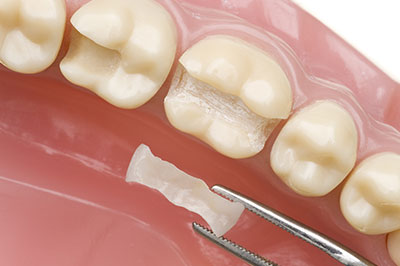
Dental inlays and onlays offer an excellent alternative to “direct” amalgam or composite fillings to restore teeth that have sustained some damage, but not enough to require a full coverage crown. While “direct” fillings such as dental amalgam and composite fillings are placed immediately after the decay or damage is removed and the tooth is prepared, inlays and onlays are known as “indirect” fillings. This means that they are fabricated outside of the mouth prior to final bonding or cementation.
While in the past, many inlays and onlays were caste from gold; today’s dental inlays and onlays are typically custom made of either the highest grade of dental porcelain or composite resins. In addition to providing an exact match to the color of tooth for a cosmetically pleasing result, inlays and onlays have the distinct advantages of being more durable than other fillings, preserving more underlying tooth structure and actually strengthening the tooth so that it can bear up to 50 to 75 percent more chewing forces.
Inlays and onlays only differ from each other in the amount of tooth structure they cover. An inlay is fabricated when the replacement of tooth structure does not require coverage of any cusp tips. If the damage from decay or injury is more extensive and involves more of the tooth’s chewing surface, including one or more cusp tips, an onlay is required.
Both inlays and onlays are fabricated outside of the mouth based upon the exact specifications provided by an impression of the prepared tooth. The final inlay or onlay is then custom made by either a dental laboratory or in-office with a same day system.


Inlays and onlays are indirect restorations made outside the mouth to repair damage to the chewing surfaces of posterior teeth. An inlay fits within the cusps of a tooth, while an onlay covers one or more cusps and can restore a larger portion of the biting surface without requiring a full crown. Unlike direct fillings that are placed and shaped chairside, inlays and onlays are custom fabricated for precise fit and contour.
Because they are produced from durable, tooth-colored materials such as porcelain or ceramic, inlays and onlays offer superior aesthetics and stain resistance compared with many traditional restorations. Their fabrication process allows for careful control of shade, texture, and occlusal anatomy, which contributes to a seamless transition with the natural tooth. This indirect approach also enables a conservative preparation that preserves more tooth structure than full-coverage crowns.
Good candidates are patients with moderate decay, a failed filling, or structural damage that is too extensive for a direct filling but does not require a crown. Teeth that retain solid cusps and have adequate root support are typically well suited for these restorations, as the remaining tooth structure can be conserved and reinforced. Your dentist will evaluate the extent of damage, remaining enamel, and occlusion to determine the least invasive option that provides reliable protection.
Patients who prefer a conservative approach or who have sensitivities to metal often choose ceramic inlays and onlays for their biocompatibility and natural appearance. Because modern adhesive systems can bond restorations to tooth structure, inlays and onlays can also strengthen weakened teeth and help redistribute biting forces. A clinical exam and diagnostic imaging provide the information needed to recommend the optimal restorative plan for each individual.
Common materials include high-quality porcelain, pressed ceramic, and other tooth-colored ceramics designed for strength and translucency. These materials are selected because they mimic the optical properties of enamel, resist staining, and provide excellent wear characteristics for posterior teeth. Metal alloys were traditionally used for strength, but tooth-colored ceramics are now often preferred for their aesthetic advantages and biocompatibility.
Material choice depends on factors such as the location of the tooth, occlusal forces, and esthetic priorities; ceramics are ideal when a natural appearance is important, while certain reinforced ceramics may be chosen for high-stress areas. Modern laboratory and CAD/CAM ceramics are engineered to balance toughness and esthetics, and they work well with contemporary adhesive protocols to create a durable bond to the tooth. Your dentist will discuss material options and select the one that best suits function and longevity.
Placement begins with a comprehensive exam and imaging to assess the tooth, followed by gentle preparation to remove decay and shape the cavity for a retentive restoration. A digital scan or precision impression captures the prepared tooth and opposing bite; if CAD/CAM is available, the restoration can often be designed and milled the same day. When a laboratory fabrication is needed, a temporary restoration may be placed while the final piece is being made.
At the bonding appointment the dentist checks shade, fit, and occlusion before using adhesive systems to bond the restoration to the tooth, creating a strong micro-mechanical union. Final polishing and occlusal adjustments ensure comfort, proper bite, and a natural feel. Patients typically notice improved chewing efficiency and an esthetic result that blends smoothly with adjacent teeth.
The primary advantage is conservation of natural tooth structure: inlays and onlays replace only the damaged portions of a tooth rather than requiring circumferential reduction. Preserving enamel and dentin supports long-term tooth vitality and reduces the risk of complications associated with more extensive preparations. This conservative approach aligns with minimally invasive dentistry principles that focus on maintaining as much healthy tooth as possible.
Additionally, well-made ceramic inlays and onlays can reinforce weakened tooth architecture and provide excellent wear resistance when bonded with modern adhesives. Their custom fabrication leads to precise marginal fit, which lowers the risk of recurrent decay and contributes to a comfortable bite. Aesthetically, tooth-colored materials offer a natural translucency that blends with surrounding teeth better than metal restorations.
With proper care, inlays and onlays can last many years—often a decade or longer—depending on material selection, oral habits, and regular maintenance. Daily oral hygiene, including brushing with fluoride toothpaste and flossing, helps prevent decay at restoration margins and preserves surrounding tooth structure. Avoiding very hard or abrasive foods and addressing habits like clenching or grinding with a nightguard can reduce the risk of premature wear or fracture.
Routine dental checkups and professional cleanings allow your clinician to monitor the restoration, assess marginal integrity, and detect early signs of wear or leakage. If repairs are needed, contemporary adhesive protocols sometimes permit repair of the existing restoration rather than replacement, staying true to conservative treatment goals. Early detection and timely maintenance support the longest possible service life for these restorations.
Yes, when a practice has in-office CAD/CAM technology and milling capabilities, a custom restoration can often be designed, milled, and bonded in a single visit. The digital workflow begins with a scan of the prepared tooth, computer-aided design, and on-site milling from a ceramic block, followed by finishing and placement. This same-day approach eliminates the need for a temporary restoration and shortens treatment time for many patients.
When laboratory fabrication is used instead, the process typically requires two visits: one for preparation and impression or scan and a second for final bonding once the piece returns from the lab. Both approaches deliver precise, well-fitting restorations; the choice depends on clinical considerations and the technology available in the office. Your dentist will explain the recommended workflow based on what will achieve the best long-term outcome.
Yes, ceramic and porcelain inlays and onlays are widely used for patients with sensitivities to metal because they are metal-free and biocompatible. These tooth-colored materials avoid the potential for galvanic reactions and allergic responses associated with some metal alloys. Choosing ceramic options allows patients to receive durable restorations without exposure to metals they may react to.
The practice will review medical and dental histories to identify any known sensitivities and recommend materials accordingly. When concerns exist, the clinician can explain material properties and help select the most appropriate ceramic or composite option that balances esthetics, strength, and biocompatibility. This personalized selection supports comfort and long-term oral health.
Like any dental restoration, inlays and onlays carry some risks, including marginal leakage, wear, fracture, or sensitivity if bonding is not optimal or if occlusal forces are excessive. Poorly fitting margins can increase the chance of recurrent decay, so precision in fabrication and bonding is essential to minimize these issues. Proper case selection and preparation also reduce the likelihood of complications by ensuring the restoration suits the remaining tooth structure.
Postoperative sensitivity is usually temporary and can resolve as the adhesive sets and the tooth adapts; persistent symptoms should be evaluated promptly. Regular monitoring during dental checkups allows for early detection of wear or failure and can often permit conservative repair rather than full replacement. Your dentist will discuss these considerations and plan treatment to reduce risks and support a successful outcome.
Precision starts with a thorough clinical exam, high-quality imaging, and careful tooth preparation to create a stable, retentive form for the restoration. Digital scans or accurate impressions capture fine details of the prepared tooth and surrounding occlusion, while shade selection and surface characterization are used to match adjacent teeth. When CAD/CAM technologies are available, in-office design and milling allow for tight tolerances and rapid adjustments.
The practice emphasizes conservative, minimally invasive techniques and uses advanced adhesive systems and polishing protocols to achieve a natural transition between restoration and enamel. Final occlusal adjustments and polishing ensure comfort and harmonious function within the bite. At the office of Angela Laithangbam, DDS Inc., these combined steps support predictable, durable, and esthetic posterior restorations.
Ready to schedule your next dental appointment or have questions about our services?
Contacting Hearth Dental Practice is easy! Our friendly staff is available to assist you with scheduling appointments, answering inquiries about treatment options, and addressing any concerns you may have. Whether you prefer to give us a call, send us an email, or fill out our convenient online contact form, we're here to help. Don't wait to take the first step towards achieving the smile of your dreams – reach out to us today and discover the difference personalized dental care can make.