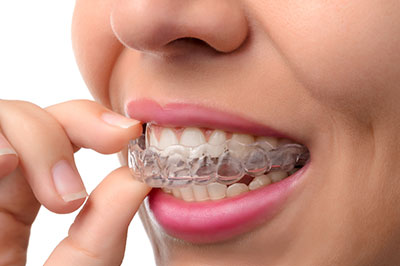
Invisalign® is a form of orthodontic treatment that works to correct many different types of malocclusions through the use of a series of clear plastic trays called aligners. As a more discreet, comfortable and completely removable method of care, Invisalign aligners provide an effective alternative to traditional orthodontic braces and metal wires for certain types of malocclusions.
Developed by a team of Stanford University students, the advanced 3D imaging, modeling, and aligner technology that defines the Invisalign system of care was introduced to the public in the year 2000. Since that time, it has become an extremely popular option in care.
Invisalign uses advanced 3-D computer imaging technology to formulate a sequence of custom-made clear aligners. The aligners, each of which is worn for a couple of weeks, incrementally move the teeth into place until the final desired corrections are reached. The advantage and appeal of the Invisalign method are that the clear aligners are more cosmetic, comfortable and convenient than other orthodontic appliances and operate with minimal interference to daily activities. Invisalign allows teens and adults to enjoy eating all of their favorite foods, and engage in sports without the fear of breaking their orthodontic appliances or sharp poking wires. Moreover, as the aligners are completely removable, tooth brushing and flossing are much easier as there is no need to clean in between any attached orthodontic brackets or wires.
*Invisalign is a registered trademark of Align Technology, Inc.


There are many options for patients who want to avoid metal braces! The most popular alternative orthodontic treatment is Invisalign®, which are clear plastic aligners designed to straighten teeth. After an examination of your teeth, your dentist will determine which option is best suited to your wants and needs.
According to the Invisalign® website, the cost for treatment is approximately the same as the cost for metal braces. A portion of this cost may be covered by your insurance. Please call us to set up a consultation and discuss potential payment plan options.
The first step is to schedule a consultation with your doctor, so they can devise a treatment plan that is best suited to your individual dental needs. Once approved, you will receive your first set of aligners. Your doctor will then regularly monitor the movement of your teeth and new aligners will be ordered according to the progress made in your treatment plan.
Invisalign® aligners are made of clear, flexible plastic. The company received a patent for this material – SmartTrack® – to be used exclusively for Invisalign treatment purposes. These aligners are FDA approved and nearly invisible!
Your doctor will give you an estimate regarding how long your Invisalign® treatment should take, which will depend on your specific needs. The average length of time for treatment is approximately 12-18 months. However, some patients may see results far sooner. Remember to wear your aligners exactly as instructed by your doctor to obtain the best results.
Your doctor will most likely recommend that you wear retainers following your Invisalign® treatment. This is a precaution that will prevent your teeth from shifting back to their original positioning. It is important to follow your doctor's instructions exactly to ensure long-lasting results.
You must wear your aligners for up to 22 hours daily. You may remove them for eating, drinking and regular oral hygiene.
No. Unlike braces, you may eat whatever you like as long as you remove the aligners before eating. Prior to placing the aligners back on, it is important to brush your teeth and the aligners after you eat.
Like any orthodontic treatment, there is a short adjustment period. The more you speak with the aligners on, the quicker you will adjust.
There will be some pressure and minor discomfort for a day or two after each initial insertion. This is a sign that your teeth are moving sequentially into their final position.
It is recommended that you remove your aligners prior to chewing gum as the gum will stick to the aligners.
We discourage smoking with aligners as the cigarette smoke will tend to discolor them.
Brushing them with toothpaste will keep them fresh and clean.
Regular office visits are every five to six weeks. This will ensure that your Invisalign treatment is progressing as planned.
All orthodontic patients are instructed to wear their retainers at night indefinitely. Sleeping with your retainers in at night will ensure a healthy bite and maintain the new position of your teeth.
Yes, if their teeth, including second molars, have grown in completely.
Invisalign is a system of clear, removable aligners that gradually shift teeth into their desired positions. Unlike traditional braces, it relies on a series of transparent trays rather than metal brackets and wires, which makes the appliances far less visible during treatment. Each set of aligners is custom fabricated from digital records to move specific teeth according to a planned sequence.
The treatment emphasizes detailed digital planning and predictable staging of tooth movements using 3-D software. Because the trays are removable, patients can maintain normal oral hygiene and eat without the dietary restrictions associated with fixed appliances. This combination of aesthetics, convenience, and clinical planning is why many patients consider clear aligners when appropriate for their needs.
Good candidates for Invisalign include many adults and teens who have mild to moderate crowding, spacing, or certain bite irregularities. A comprehensive dental exam is necessary to assess gum health, the presence of restorations, and jaw function, since active periodontal disease or certain untreated dental issues must be addressed first. The clinical suitability depends on the complexity of the problem and the patient’s willingness to follow the wear protocol.
Some complex orthodontic cases may require adjunctive procedures or alternative approaches, and those determinations are made during the evaluation. The clinician will review your dental history, take digital scans and radiographs, and discuss realistic outcomes before recommending aligner therapy. A personalized assessment ensures the chosen path supports both aesthetic goals and long-term oral health.
Treatment begins with a thorough consultation that includes a clinical exam, digital scans, and diagnostic records to evaluate alignment, bite, and overall oral health. These digital impressions form the basis of a 3-D treatment plan that maps each stage of movement and generates a visual preview of likely results. That plan is reviewed and refined by the clinician to align clinical judgment with the digital simulation.
Once the aligners are fabricated, patients wear a sequence of trays, changing them on a prescribed schedule to advance tooth movement. Regular check-ins allow the clinician to monitor progress and request refinements if needed to achieve the planned outcome. When the active phase is complete, a retention strategy is implemented to preserve the final alignment and protect long-term stability.
Throughout the process, patient cooperation with wear time and oral hygiene plays a major role in the efficiency of treatment. The practice will provide instructions on care, wearing schedules, and what to expect during transitions between aligners. Clear communication and clinical oversight together help deliver predictable, lasting results.
Proper aligner care begins with routine cleaning: rinse trays after removal, brush them gently with a soft toothbrush and mild soap or the cleaning solution recommended by your clinician, and avoid hot water that can warp the material. Always store aligners in their protective case when not being worn to reduce the risk of damage or loss. Cleaning both teeth and trays regularly minimizes staining and helps maintain oral health throughout treatment.
Maintain normal brushing and flossing habits and be sure to clean your teeth after eating before reinserting aligners to prevent trapping food particles against enamel. Regular dental cleanings and examinations during treatment help detect and address any issues early. If an aligner becomes damaged or no longer fits correctly, contact the office for guidance rather than attempting home repairs.
Most patients experience only temporary changes in speech when they first begin wearing aligners, such as a slight lisp that typically resolves within a few days as the tongue adjusts. Practicing speaking aloud and wearing the aligners as recommended helps speed adaptation. Long-term speech effects are uncommon once the wearer becomes accustomed to the trays.
Some sensitivity or pressure is normal when switching to a new tray, as that sensation indicates the teeth are moving. Discomfort is usually mild and short-lived and can often be managed with over-the-counter pain relief and cold compresses if needed. Persistent or severe pain should be evaluated by the clinician to rule out other concerns and to ensure the treatment is progressing as planned.
Treatment time for Invisalign varies considerably based on the complexity of the case, the number of movements required, and the patient’s adherence to the prescribed wear schedule. Simple corrections may complete in several months, while more involved alignment or bite adjustments can take a year or longer. A personalized treatment plan created from digital records gives the best estimate of expected duration.
Patient compliance is one of the most important determinants of how quickly treatment progresses, since aligners must be worn for the recommended daily hours to be effective. The need for refinements or additional aligner stages can extend the timeline but also improves the final outcome when used judiciously. Regular clinical reviews help keep the plan on track and allow timely adjustments when necessary.
We rely on high-resolution digital scanning and three-dimensional treatment planning software to create accurate impressions and a step-by-step roadmap of tooth movements. Tools such as an intraoral scanner and digital models allow clinicians to visualize outcomes before fabrication, improving predictability and patient understanding. These technologies also reduce the need for traditional impression materials and increase the precision of aligner fits.
Advanced manufacturing methods and contemporary aligner materials contribute to consistent force delivery and patient comfort, while clinical oversight tailors the digital plan to each patient’s anatomy. The office of Angela Laithangbam, DDS Inc. integrates these tools with conservative treatment principles to achieve stable, functional results. Periodic digital monitoring and in-person checkups ensure progress matches the planned trajectory and allow timely refinements when indicated.
Yes, retainers are typically recommended after any active tooth movement to maintain the new alignment and prevent relapse. Retention strategies vary and may include removable retainers worn nightly or fixed retainers bonded to the inside surfaces of teeth, depending on the clinical situation and patient preference. Your clinician will explain the retention options and help choose the approach that best supports long-term stability.
Following the prescribed retention schedule and attending follow-up visits helps ensure the investment in treatment is preserved. Retainers can wear over time, so periodic evaluation and replacement when necessary support ongoing effectiveness. A clear retention plan is an integral part of the overall treatment pathway and is discussed before finishing active alignment.
Invisalign can address a wide range of alignment and bite concerns, including crowding, spacing, and certain types of overbites, underbites, and crossbites when planned appropriately. Advances in digital planning, attachments, and auxiliaries have expanded the scope of cases that can be treated predictably with clear aligners. However, some complex skeletal or severe bite discrepancies may still be better managed with alternative orthodontic approaches or interdisciplinary care.
A careful clinical evaluation identifies whether aligner therapy alone is suitable or if adjunctive treatments—such as selective tooth restorations, interproximal reduction, or coordination with an orthodontist—are needed to achieve optimal results. The clinician will discuss realistic expectations and any recommended supplemental therapies during the consultation. Choosing the right method up front helps protect dental health while achieving a functional, aesthetic outcome.
The practice emphasizes a minimally invasive philosophy that prioritizes preserving natural tooth structure and long-term oral health while pursuing alignment goals. This approach combines evidence-based decision making, precise diagnostics like digital scanning, and adjunctive technologies such as the intraoral camera and laser when appropriate. Thorough evaluation of remineralization potential, gum health, and bite function ensures that orthodontic planning supports overall dental wellness.
Patient education and collaborative care are central to the treatment experience, with clear explanations of mechanics, hygiene responsibilities, and follow-up expectations. Regular clinical reviews allow the team to monitor progress and make conservative refinements as needed to protect function and aesthetics. At our Mountain View location, the team at Angela Laithangbam, DDS Inc. aims to deliver predictable, comfortable aligner therapy while maintaining a focus on long-term stability and patient well-being.
Ready to schedule your next dental appointment or have questions about our services?
Contacting Hearth Dental Practice is easy! Our friendly staff is available to assist you with scheduling appointments, answering inquiries about treatment options, and addressing any concerns you may have. Whether you prefer to give us a call, send us an email, or fill out our convenient online contact form, we're here to help. Don't wait to take the first step towards achieving the smile of your dreams – reach out to us today and discover the difference personalized dental care can make.